

Week 2- Peace
Art & Artist Highlight


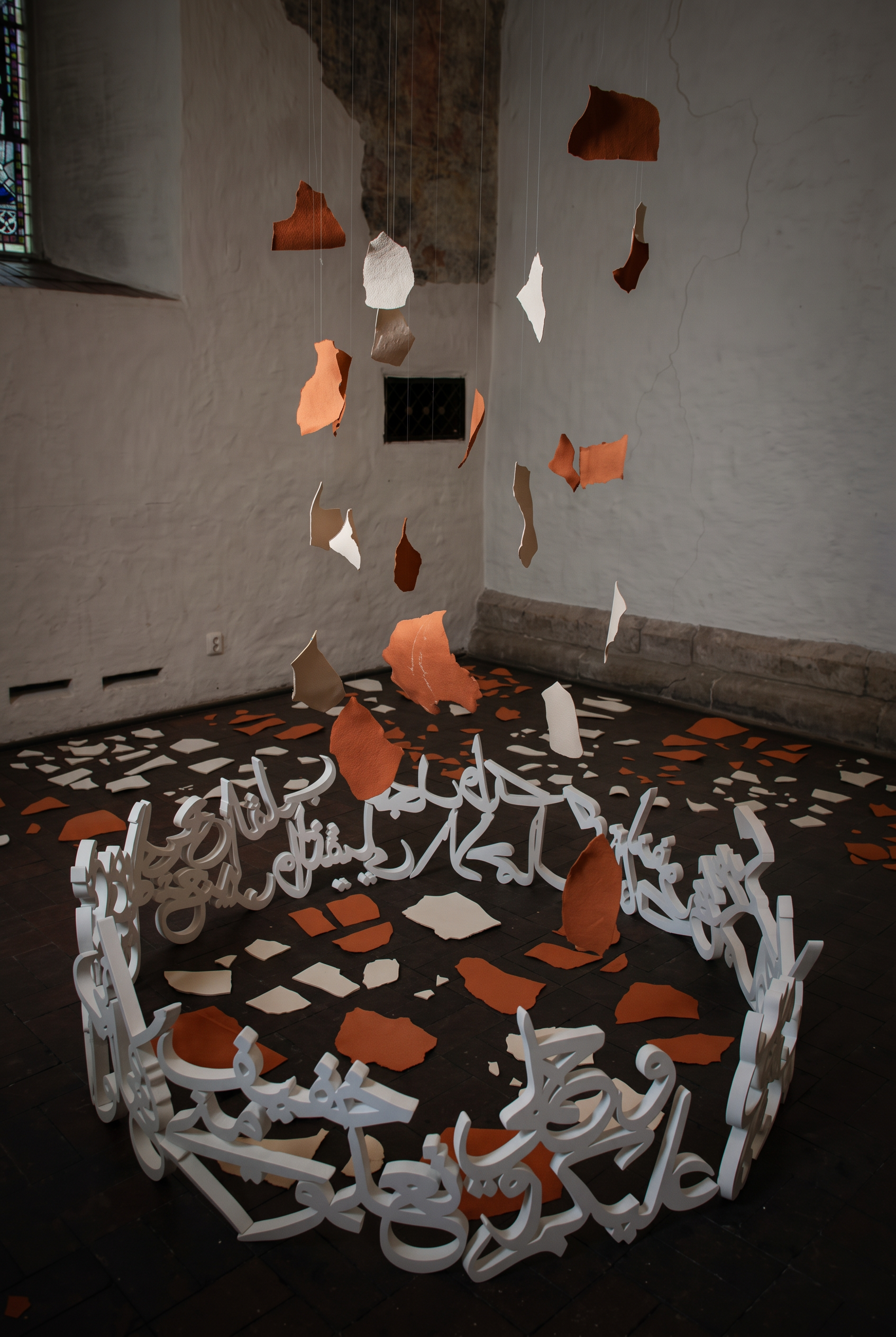
In Search of the Incomplete by Faten Natas Mitwasi
Terracotta clay and condensed polystyrene
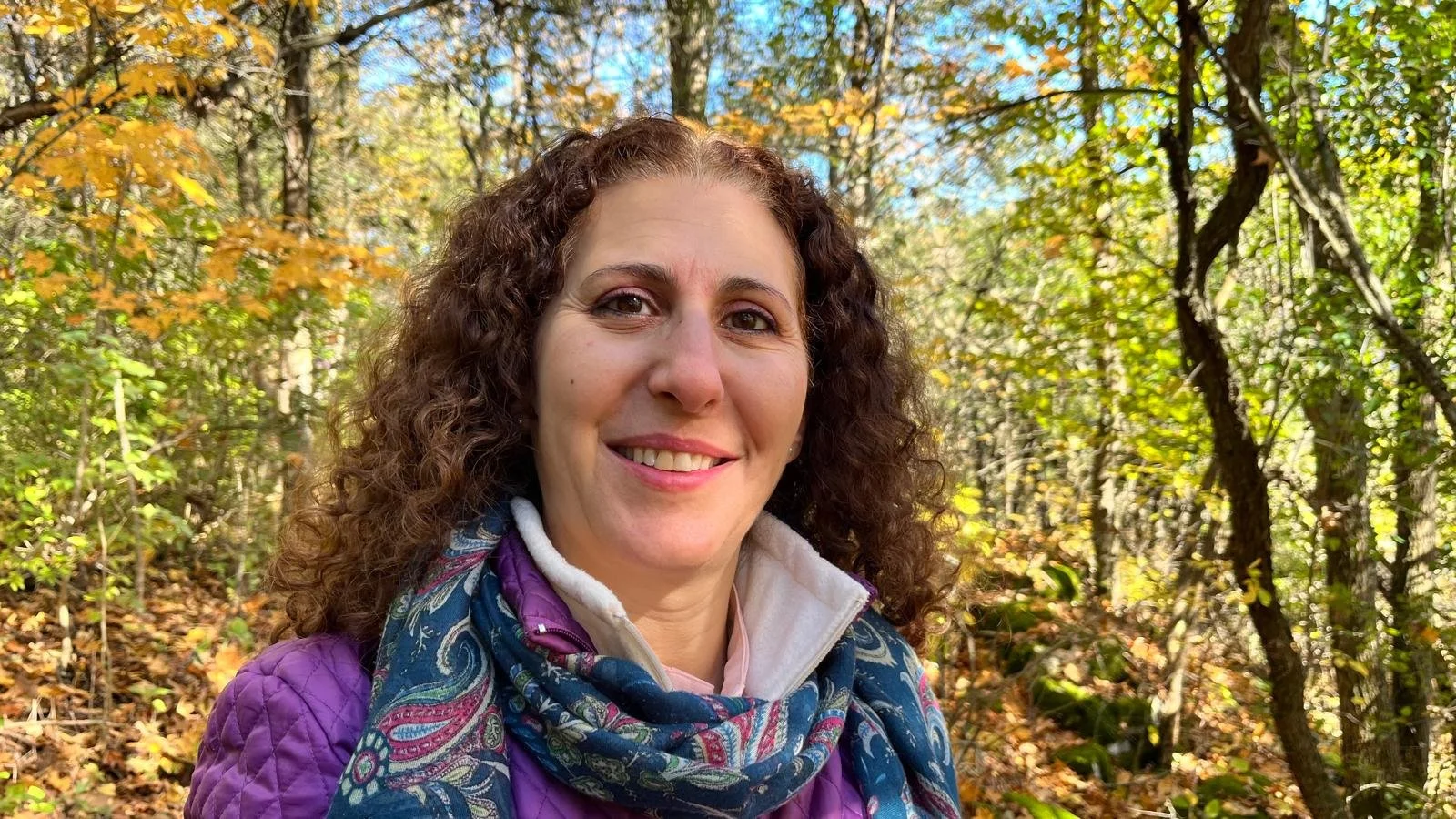
FATEN NATAS MITWASI
Born and raised in Bethlehem to a Christian family with a long lineage of master stone sculptors, Faten holds an MFA and is currently pursuing her PhD in Screen Cultures and Curatorial Studies at Queen’s University in Ontario, Canada. Drawing on her ancestral artistic practices, Faten’s artistic and scholarly work explores survival, cultural memory, resistance, and transnationality through multimedia installations, ranging from hand-crafted objects to digital media and curatorial work grounded in Palestinian visual culture and heritage.
The Church of Sweden commissioned In Search of the Complete, which was exhibited at Vaxjo Cathedral. The work explores the fragmentation of identity. Terracotta fragments, bearing traces of Palestinian embroidery like fossils, are scattered around a sculpture of Arabic calligraphy featuring the biblical passage from Matthew 11:28–30, in which Jesus invites the weary and burdened to come to Him, take His yoke, and find rest in our souls.
Week 1 - Hope
Story
Violence in the Everyday | Ghadeer Y
One of my most cherished childhood memories is Christmas Eve, 1986. I was seven years old. It was also the last Christmas of my innocence.
We lived in the predominantly Muslim part of Ramallah, and in our community, we celebrated each other’s religious holidays. When Ramadan came, we got invited to iftars, and when the feast of St. Barbara came, my mother made wheat porridge for the whole neighborhood. Easter meant a neighborhood-wide egg hunt! These joint celebrations are one of the most beautiful things about our society.
And so, during the Christmas of 1986, my father decided to bring Santa to our neighborhood and give toys to the kids in our block. He picked and purchased every toy himself.
That Christmas Eve was unforgettable, with the thrill of waiting with all the other kids huddled by the door of our apartment, and the arrival of Santa finally pulling up in a honking, jingling car decked with bells! Our “Santa” was not a jolly old man from the North Pole, but rather the owner of the local toy shop. My heart was bursting with pride and joy, as we all sat on the stairs unwrapping, comparing, and giggling, while the parents socialized and sipped tea. My father became a neighborhood hero!
Exactly a year later, I overheard my parents discussing the Santa situation. It seemed that our “Santa”--the owner of the toy store-- was beaten to a pulp by Israeli soldiers. You see, in 1987, Palestinians determined that they’d had enough of the occupation and took to the streets in protest. We called it the Intifada (uprising). Between curfews, ruthless crackdowns, and a boiling youth yearning for freedom, life seemed to have stopped for us kids, while we carried the weight of our cause and the brutality of our occupier. Eventually, our “Santa” closed his toy shop and left for America. And like so many Christmases during that period, we kept subdued holidays with church and family gatherings in solidarity and mourning.
This was one of many formative experiences that shaped my consciousness about life, celebration, and imagining the future. I later learned that this is called “foreshortened future”: a trauma symptom where a child is unable to conceive of the future. During those years, I developed an overwhelming sense that I would not grow up, and that life would never be normal again. It felt the strongest around Christmas, with the question: will Christmas come again this year?
Over the years, Christmas celebrations and festivities became the barometer of our reality in Palestine. For both Christians and Muslims, they ebb and flow with the collective grief and hope of our people.
My generation lived through the First and Second Intifadas; the Oslo “Peace Process”; the collapse of the Oslo agreement; the multiple wars on Gaza; and now the genocide in Gaza and rapid acceleration of settler violence, settlement expansion, and fragmentation of the West Bank.
Since 1987, every December brings the same uncertain question: will the scout bands fill our streets with music? Will our trees be lit, or will we mourn instead of celebrate?
Will we be able to drive to Bethlehem and celebrate in Manger Square, while almost a thousand Israeli checkpoints disrupt our connectivity and threaten to fragment our communities?
Will we even make it to our church in Ramallah? As I write these words, a new Israeli “gate” is being set up in the middle of our town.
Most of all, I wonder: how will our people in Gaza endure yet another winter under the cover of tents and hellfire? Will the children of Gaza ever experience a Christmas like mine in 1986?
I pray. I wonder. Lord have mercy.
Support the ministry
of Palestinian Christians.


In Partnership with